English
 Español
 لالعربية

Beverage Filling Production Lines
release time:
2026-10-22
Beverage Filling Production Lines: Equipment Components, Production Processes, a
Beverage Filling Production Lines: Equipment Components, Production Processes, and Purchasing Guide
Why do beverage manufacturers need a complete automated filling line?
As the beverage market evolves, production facilities must continuously improve efficiency while maintaining consistent product quality. For beverage plants with high order volumes, production methods that rely heavily on manual labor may struggle to meet growing demand; they also increase the burden of personnel management, product handling, and the coordination of various operational stages.
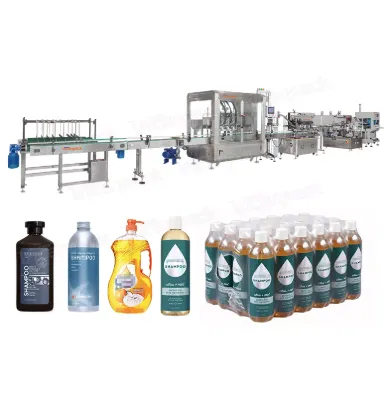
An automated beverage filling line integrates multiple production steps—such as empty bottle conveying, rinsing, liquid filling, capping, labeling, coding, and packaging—into a cohesive system. By configuring the equipment appropriately, companies can reduce repetitive manual tasks and ensure a more seamless production flow.
What equipment makes up a beverage filling line?
A beverage filling line is a system of equipment designed for the production and packaging of bottled liquid products. Depending on the product type, production process, and specific client requirements, a complete line may include filling equipment, capping machines, conveying systems, labeling equipment, coding/marking systems, and end-of-line packaging machinery.
For beverages such as fruit juices, tea-based drinks, or carbonated beverages, the filling technology must be selected based on the specific characteristics of the product. Since different beverages vary in terms of temperature, viscosity, foaming tendencies, hygiene requirements, and packaging conditions, a "one-size-fits-all" equipment solution is rarely appropriate.
Workflow of a Beverage Filling Line
A beverage production line can be structured according to the following workflow:
Step 1: Prepare the beverage to meet production specifications, ensuring it undergoes the necessary processing.
Step 2: Convey empty bottles onto the production line.
Step 3: Rinse the bottles or perform other required preparatory treatments, depending on the equipment configuration.
Step 4: Fill the bottles with the beverage using filling equipment suited to the specific product.
Step 5: Seal the bottles using a capping machine and conduct any necessary quality checks as required by production standards.
Step 6: Apply labels and print product information using labeling and coding/marking equipment.
Step 7: Transport the products to the end-of-line packaging equipment for boxing, shrink-wrapping, or other final packaging processes. It should be noted that the process described above is a common example and does not represent a fixed procedure applicable to all beverage products.
Carbonated drinks, hot-filled beverages, and other products with specific processing requirements may necessitate different equipment configurations and production steps.
How to select the right beverage filling production line?
Determine bottle specifications and filling capacity:
Before procurement, provide details such as bottle material, shape, dimensions, neck specifications, and filling volume.
Determine production capacity based on actual requirements:
Enterprises should define their target production output (per hour or per day), as well as projected operating hours and order demands.
When evaluating production capacity, consider filling speed, capping speed, labeling capacity, packaging speed, and equipment uptime. The actual output of an entire line is typically constrained by the process step with the lowest capacity, as well as any equipment downtime.
It is advisable to confirm the testing conditions for capacity, compatible bottle types, and product specifications with the equipment supplier prior to purchase.
Consider facility and utility requirements:
Equipment selection must account for available floor space, production line layout, power supply, compressed air, water supply, drainage, and any necessary environmental control conditions.
For a complete production line, ensure sufficient space is allocated for equipment maintenance, operator access, and material handling.
Verify hygiene, cleaning, and compliance requirements:
The materials, construction, cleaning methods, and configurations of food and beverage production equipment must align with the specific product process and the requirements of the target market.
Purchasers should verify the suitability of the equipment—and the technical documentation provided by the supplier—against local regulations and product standards. Do not assume that a production line complies with all national or regional regulations based solely on promotional materials.
Evaluate supplier technical support:
Procuring an entire production line involves more than just the equipment cost; it encompasses project coordination, installation, commissioning, operator training, spare parts supply, and ongoing maintenance.
When comparing suppliers, assess their ability to provide detailed equipment configuration lists, layout plans, technical specifications, operating manuals, and the necessary after-sales support for your project.
Key Advantages of Automated Beverage Filling Production Lines
1. Improving production processes
2. Supporting higher production demands
3. Enhancing consistency in the filling process
4. Optimizing personnel allocation
5. Providing support for future production expansion
label: